Optimality and uniqueness of Romik's ambidextrous sofa in Lean 4
A Lean 4 proof that Romik's ambidextrous sofa is the largest shape that can turn both right and left around the corner of a hallway, and that it is the only one, up to rigid motions.
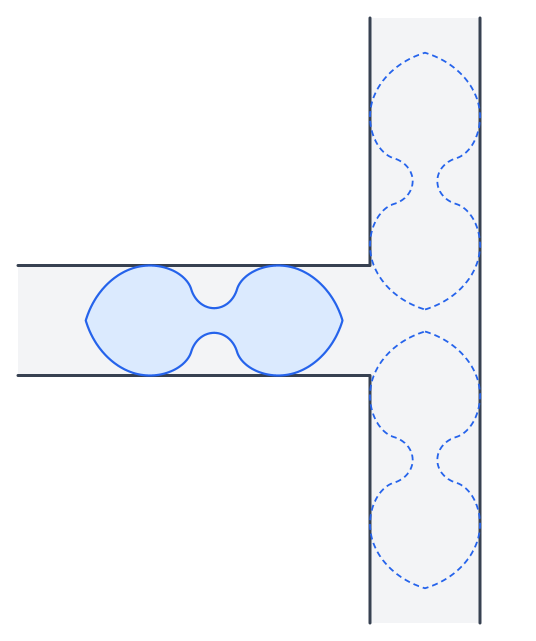
The moving sofa problem asks for the largest shape that can be carried around the corner of a hallway of width \(1\) that turns right. In its ambidextrous variant the shape must also get around a hallway that turns left, from the same starting position, so the sofa must be smaller.
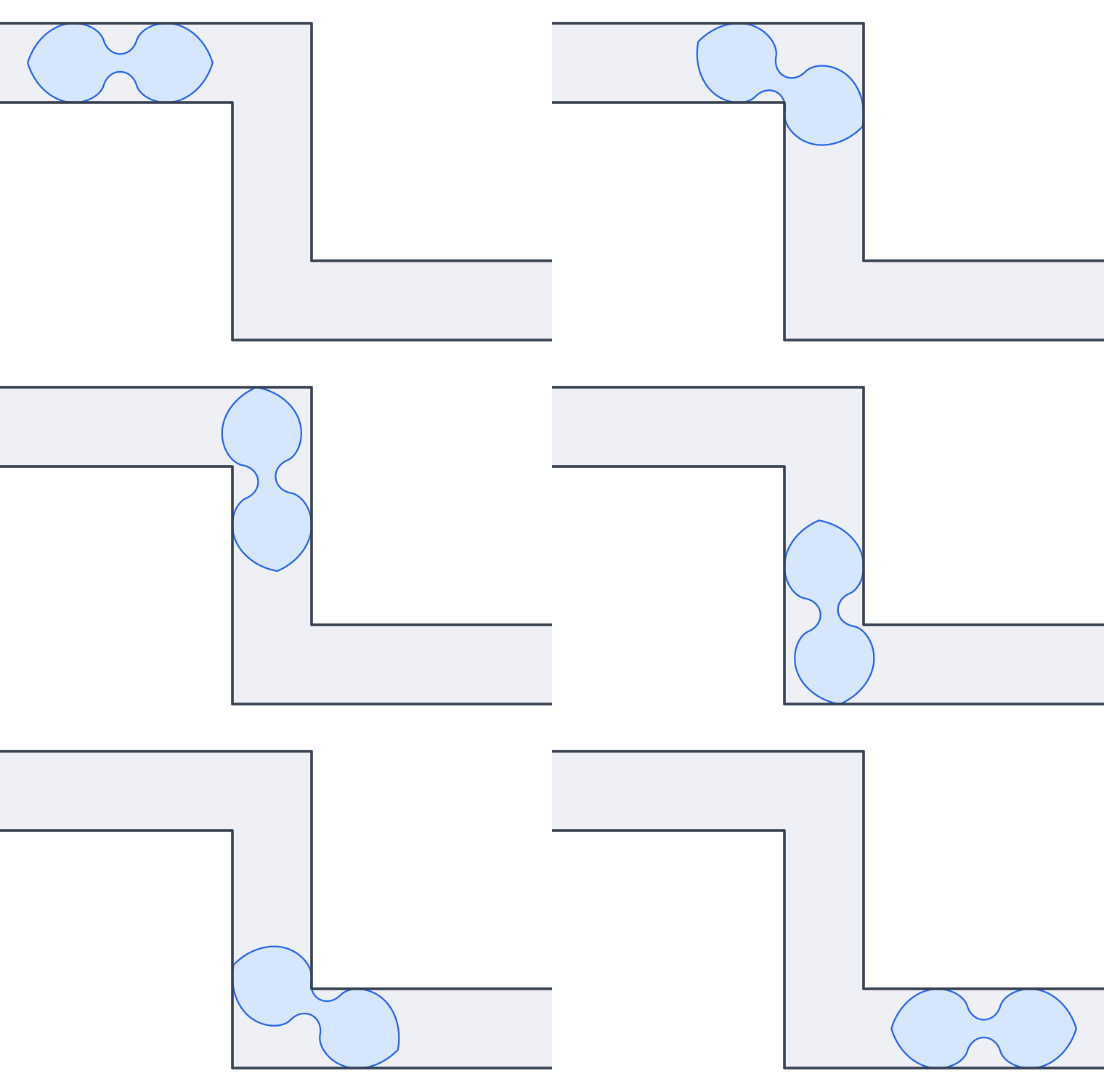
In 2016 Dan Romik built a shape for this problem from differential equations and proposed it as a likely solution. Its area is
\[M = 1 + 4Y^2 + \arctan Y = 1.64495\ldots,\]where \(Y = 0.2980\ldots\) is the positive root of \(4Y^3 + 3Y = 1\). This project proves in Lean 4 that Romik’s sofa is optimal, and that every ambidextrous sofa of area \(M\) is Romik’s sofa after a rotation and a translation.
The problem
The plane is \(\mathbb{R}^2\), and the area of a set is its Lebesgue measure. Both hallways come in along the arm \((-\infty, 1] \times [0, 1]\). The one that turns right leaves along \([0, 1] \times (-\infty, 1]\), and the one that turns left along \([0, 1] \times [0, \infty)\). An ambidextrous sofa is a compact connected set that moves through both hallways by two continuous rigid motions, starting with the same orientation. The motions may pause, turn back, and turn through any angle.
Without the common starting orientation the answer would be Gerver’s area \(2.2195\ldots\): Gerver’s sofa, the answer to the ordinary problem, is symmetric in a vertical line, so after a half turn it passes the left-turning hallway too.
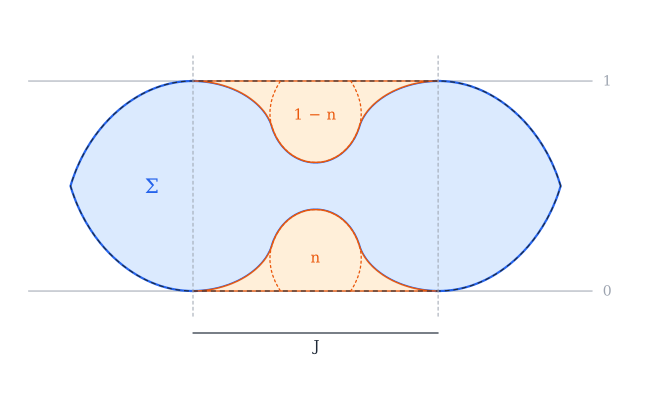
Romik’s sofa is given by the support function of its convex hull, an explicit formula in three phases, with two open regions removed from the hull: the niche swept by the inner corner of the right-turning hallway as the hallway turns about the sofa, and its mirror image for the left-turning hallway. The sofa is symmetric in the line \(y = 1/2\), so uniqueness up to rotations and translations is uniqueness up to congruence.
The results
The project states nine theorems in a file that imports only Mathlib. The main ones are:
- Every ambidextrous sofa has area at most \(M\).
- An ambidextrous sofa has area \(M\) if and only if it is a rotated and translated copy of Romik’s sofa.
- In an ambidextrous sofa of area \(M\), each of the two motions turns the sofa through a full quarter turn at some moment.
The others check the construction: Romik’s sofa and its copies are ambidextrous sofas, its area is \(M\), its convex hull is the body given by its support function, \(4Y^3 + 3Y = 1\) has exactly one positive root, and \(M\) equals Romik’s closed form
\[\sqrt[3]{3 + 2\sqrt2} + \sqrt[3]{3 - 2\sqrt2} - 1 + \arctan\left(\tfrac12\left(\sqrt[3]{\sqrt2 + 1} - \sqrt[3]{\sqrt2 - 1}\right)\right).\]The proof
A sofa whose motions turn it by at most \(\pi/4\) has area at most \(\sqrt2 < M\), so the proof can keep, for each motion, an angle in \((\pi/4, \pi/2]\) through which the sofa has turned. After moving the sofa into the strip \(0 \le y \le 1\), its convex hull splits into an upper cap \(U\) and a lower cap, whose reflection is \(V\). The area of the sofa is at most \(P_\alpha(U) + P_\gamma(V)\), where the score \(P_\alpha\) of a cap is the area under its roof over the two outer quarters of its projection, minus the part of the middle half that the hallway’s inner corner sweeps while the hallway turns by \(\alpha\).
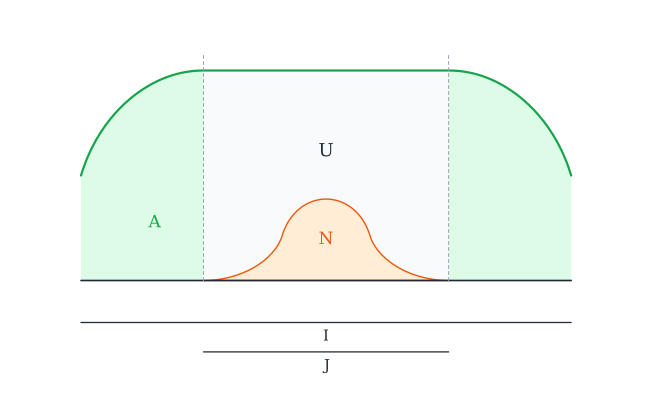
The main step bounds the score of a single cap: \(P_\alpha(U) \le M/2\), with equality only for \(\alpha = \pi/2\) and \(U\) a translate of Romik’s cap. For a full quarter turn, a cap of maximal score exists by compactness, and approximating it by polygons gives it curvature densities and conditions at its endpoints. A tilted middle roof is then ruled out, and a horizontal one is compared with a functional whose maximum \(M/2\) is reached only at Romik’s cap. For a partial turn, the score keeps the whole outgoing wall of the hallway, which makes it strictly smaller. Two of these exclusions use the bound \(2.2199\) on the ordinary problem, which comes from Jineon Baek’s theorem that Gerver’s sofa is optimal.
If the sofa has area \(M\), both caps have score \(M/2\), so both motions make a full quarter turn and both caps are Romik’s. An exact identity for the area lost then recovers the sofa from its caps.
A 109-page draft paper writes the proof out by hand.
Prior work
Leo Moser posed the moving sofa problem in 1966, and the ambidextrous variant goes back to John Conway, G. C. Shephard and others. Kiyoshi Maruyama computed polygonal approximations in 1971, and Philip Gibbs found a shape of area \(1.64495\) numerically in 2014. Romik derived his sofa from differential equations in 2016 and noted that it matches Gibbs’s shape; he called it “a highly plausible candidate” for the solution. Georgiev, Gómez-Serrano, Tao and Wagner listed the problem as open in 2025, as Problem 6.63 of Mathematical exploration and discovery at scale.
The proof uses Baek’s theorem through its Lean formalization in lean4-moving-sofa. A pull request to Google DeepMind’s formal-conjectures states the problem in Lean, and other repositories give upper bounds for it, among them Devin O’Keefe’s bound \(1.765\), proved with a checker written in Lean. The repository’s prior-work page gives the references.
Verification
Lean’s kernel checks every proof, and no person has checked them. Nothing is assumed beyond Lean’s three standard axioms. The nine theorems are stated in a self-contained Challenge file, and Comparator checks, with Lean’s kernel and with NanoDa, that the Solution proves exactly those statements. The project is registered in the Palomar registry as PALOMAR-2026-10-13-000003.
Contributors
ChatGPT Pro 6 found the proof and wrote a first Lean draft of it. Claude Opus 5.5 made the draft compile, simplified it, and wrote the Challenge, the Solution and the documentation, following my skill for formalizing papers, formalize-math-paper. Codex (GPT-6) wrote the paper and revised it together with the Lean proofs. I directed the work. The repository’s credits page records how each part was done.
References
- L. Moser, Problem 66-11, Moving furniture through a hallway, SIAM Review 8 (1966), 381.
- J. L. Gerver, On moving a sofa around a corner, Geometriae Dedicata 42 (1992), 267–283.
- D. Romik, Differential equations and exact solutions in the moving sofa problem, Experimental Mathematics 27 (2018), 316–330.
- Y. Kallus, D. Romik, Improved upper bounds in the moving sofa problem, Advances in Mathematics 340 (2018), 960–982.
- J. Baek, Optimality of Gerver’s sofa, arXiv:2411.19826 (2024).
- B. Georgiev, J. Gómez-Serrano, T. Tao, A. Z. Wagner, Mathematical exploration and discovery at scale, arXiv:2511.02864 (2025).